The Barbault Basket Is Peaking Now: What's Real, What's Viral Myth, and What It Means for You
Updated July 20, 2026: the "Barbault Basket" is a nickname for a real outer-planet configuration peaking July 19–21, 2026, named after French astrologer André Barbault. The claim spreading online — that Barbault predicted the world "ends this July" — does not match what he actually wrote.
Quick answer: The "Barbault Basket" is a nickname for a July 2026 outer-planet configuration (Jupiter, Uranus, Neptune, Pluto), peaking July 19–21, 2026. It is named after French mundane astrologer André Barbault (1921–2019) — but he never used this term. His actual 2014 writing called this period a "splendid relaunch of civilization," not an apocalypse.
Barbault Basket 2026 — Key Dates
| Window | Dates | What It Means |
|---|---|---|
| Activation window | July 15–24, 2026 | Outer planets move into the loose "basket" shape. Any effect, if real, would build gradually — it does not switch on overnight. |
| Peak | July 19–21, 2026 | The configuration is at its tightest during this 48–72 hour window — the dates most viral posts and searches reference. |
| Exact-day disagreement | Varies by source | Astrologers use different orbs (allowed degrees of separation), so some name July 19, others July 20 or 21, as the single "peak" day. |
Fact vs. Viral Claim
| Viral Claim | What's Actually Documented |
|---|---|
| "The world as we know it ends this July." | Barbault's own 2014 book calls this period a "splendid relaunch of civilization" — a recovery framing, not a collapse. |
| "Barbault coined the term 'Barbault Basket.'" | "Basket" (or "bucket") is a pre-existing generic term for a chart shape. Online astrologers applied Barbault's name to this specific 2026 event only recently — he never used the phrase himself. |
| "Barbault precisely predicted COVID-19." | Partly documented, partly overstated. In a 2011 essay (published in L'Astrologue no. 177, reprinted in his 2014 book), Barbault explicitly warned of a possible "new pandemic" around 2020–2021 — in writing, nine years early. He did not name the disease or a date, and he died in 2019 without seeing it confirmed. |
| "This is a proven forecasting mechanism." | Barbault himself described the cyclic index as a working hypothesis built from historical correlation — not a validated, causal law of world events. |
| "Something dramatic must visibly happen on July 19." | The planetary alignment is an astronomical fact, confirmable with any ephemeris. What it means for human events is an unverified interpretive layer — no single headline is predictable from the configuration alone. |
Live Update — July 20, 2026
The search spike is happening while the July 19–21 window is active, but the verifiable facts have not changed: the chart geometry is real, the "world ends this July" framing is a later viral retelling, and Barbault's own published framing was about a broader recovery cycle, not a single dramatic date.
This page will be updated again after the July 19–21 window closes. For now, the useful question is not "what headline should happen today?" but "which claims can be checked, and which claims are interpretation?" That is also why we do not optimize this page around misspellings or panic phrases. If you arrived here through a distorted query, the clean term is Barbault Basket 2026 or Barbault's Basket.
Who Was André Barbault?
André Barbault (1921–2019) was a French mundane astrologer — meaning he studied cycles in nations and civilizations, not individual birth charts. Over several decades he built a "cyclic index" (indice cyclique): a running measure of the angular relationships between the outer, slow-moving planets (Jupiter, Saturn, Uranus, Neptune, Pluto), which he used to retroactively track periods of collective crisis, including the 1929 crash, World War II, and the collapse of the Soviet Union.
His most-cited "hit" deserves precise wording, because it is stronger than skeptics assume and weaker than fans claim. In a 2011 essay (published in L'Astrologue no. 177 in early 2012, and reprinted in his 2014 book), Barbault wrote that humanity "may well be at serious risk of a new pandemic around 2020 to 2021," tied to the lowest cyclic-index reading of the 21st century. That is a genuinely forward-looking, published statement — not an after-the-fact reinterpretation. At the same time, he named no disease, no mechanism, and no precise date, and he died in 2019 without seeing the claim tested. One striking sentence is a data point, not a validated forecasting method — and that context matters for how much weight the current "Barbault Basket 2026" claims should carry.
What Is the "Barbault Basket," Exactly?
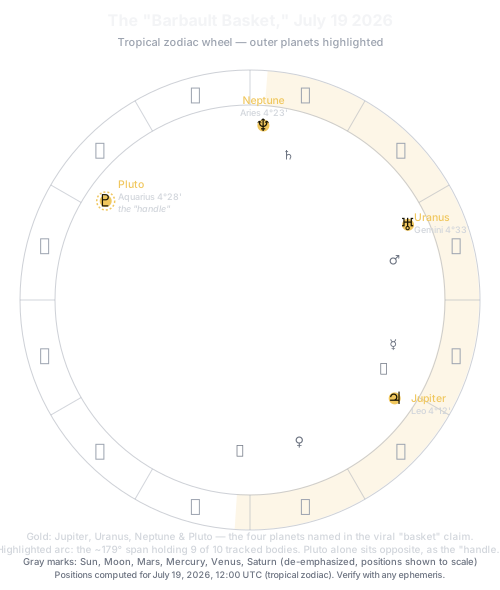
Astronomically, a "basket" (sometimes called a "bucket") describes a chart shape where most planets cluster within roughly half the zodiac, with one outlying planet sitting opposite them like a handle. It is a standard, generic term in chart-shape analysis and predates this event by decades — so if you searched "astrology basket" or "basket astrology" expecting a general definition, that is it.
We ran the actual ephemeris for July 19, 2026, 12:00 UTC to check the claim rather than repeat it secondhand. Jupiter (Leo ~4°), Uranus (Gemini ~4°), Neptune (Aries ~4°), and Pluto (Aquarius ~4°) are indeed the four planets most often named in this story, and their positions check out to within about half a degree of what's commonly cited online. But those four planets are not clustered together with each other — Jupiter, Uranus, and Neptune sit roughly 60° apart, while Pluto is nearly opposite Jupiter, on the far side of the zodiac. The actual "basket" shape only appears once you look at the *whole* chart: nine of the ten commonly tracked bodies (Sun, Moon, Mercury, Mars, Venus, Saturn, Jupiter, Uranus, and Neptune) cluster within about 179° of the zodiac, and Pluto sits alone in the remaining gap — which makes Pluto, not Jupiter, the actual "handle" of the shape. Multiple astrology sites picked up this configuration in 2025–2026 and, because Barbault's cyclic index also tracks outer-planet relationships, attached his name to it as a shorthand. "Barbault Basket" is a name given to the event by online astrologers, not a term Barbault used himself.
What Did Barbault Actually Say About 2026?
This is the part most viral posts skip. In his 2014 book, Barbault did write about 2026 — but the passage most often quoted out of context is about the Saturn–Neptune conjunction on February 20, 2026, which he treated as the real hinge point of the period, not the July planetary cluster. His framing of that hinge was recovery-oriented: he described the cyclic index climbing back out of its 2020–2022 trough and characterized the resulting period as a "splendid relaunch of civilization" — optimistic language about renewal, not a warning of collapse.
The "the world as we know it ends this July" framing traces to later, secondary retellings — for example, one widely shared Substack post built around that exact headline — rather than to Barbault's own published text. Several astrology writers have already published their own corrections: Augurine's breakdown of what Barbault actually wrote about 2020 and 2026 and The AstroTwins' explainer on the July 2026 Barbault Basket both walk through the same gap between the original source and the version circulating on social media. Additional coverage of the specific July 19–21 dates and framing is available from Sage Goddess and Paulo Mara, for readers who want to compare multiple independent write-ups.
Is Any of This "Real" Astrology?
Two different claims are getting bundled together, and separating them is the whole point of this page.
The planetary alignment itself is astronomically real. Anyone can verify the positions of Jupiter, Uranus, Neptune, and Pluto for July 2026 with a public ephemeris — that part is not in dispute and does not require trusting anyone's interpretation.
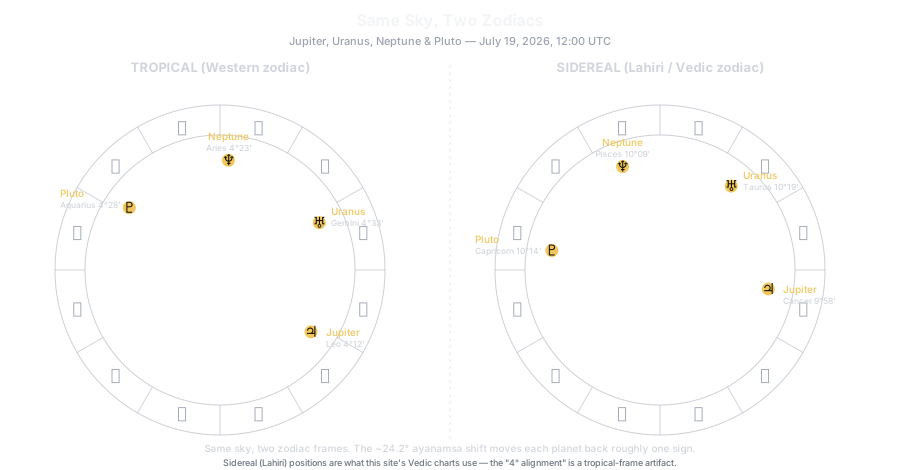
But "real" also depends on which zodiac you're using, and most of the viral posts don't mention this. The ~4° positions quoted everywhere are tropical (Western) zodiac positions. This site's charts use the sidereal (Vedic, Lahiri) zodiac instead, which is offset from the tropical zodiac by roughly 24.2° right now. Translate the same four planets into sidereal coordinates and they land in different signs entirely — Jupiter in Cancer instead of Leo, Uranus in Taurus instead of Gemini, Neptune in Pisces instead of Aries, Pluto in Capricorn instead of Aquarius. The sky hasn't changed; the ruler laid over it has. That "4° alignment" some posts treat as numerologically significant is an artifact of which zodiac frame you pick, not a fixed property of the sky.
What the alignment *means* for human or world events is a separate, interpretive layer that has not been independently validated. Barbault himself treated his cyclic index as a hypothesis worth tracking, not a proven mechanism. That distinction — astronomically checkable fact versus unverified interpretive claim — is exactly why we built this product around the idea of verifying before believing, instead of borrowing someone else's conviction.
What This Actually Means for YOUR Chart (Not the Whole World)
Mundane astrology, the branch Barbault worked in, reads collective and national-level trends from the slow movement of outer planets. It does not say anything about your individual birth chart, your career, or your relationships — it was never designed to.
Vedic astrology, the system this site uses, works differently: it reads how a specific date interacts with *your own* birth chart through transits and, more importantly, your current Dasha (planetary period) — a far narrower and more personally checkable question than "what will happen to the world." To be direct: we do not practice Western tropical mundane forecasting, and the AI reports on this site are not built on Barbault's cyclic-index methodology. If you want to know whether anything in your own timeline lines up with July 2026, the more useful step is to check your current Mahadasha period rather than reading a world-level forecast you have no way to verify.
Two Ways to Check This for Yourself
Have one concrete question about this window? Instead of trusting a vague world-level forecast, ask a specific Prashna question — for example whether to move, commit, wait, or act during this period. Ask a Vedic Prashna question →
Want to see what July 2026 looks like in your own timeline? Your current Dasha period — not a collective planetary configuration — is what Vedic astrology actually uses to judge whether a window matters for you personally. It takes a minute and costs nothing. Check your current Mahadasha →
Searching because Uranus is trending? Uranus is one of the planets repeatedly named in the Barbault Basket story, but the broader Uranus trend also includes Uranus in Gemini and Mars-Uranus searches. Read the Uranus trend explainer →
Researching the follow-up claim? A separate June 2027 "second Barbault Basket" narrative is already circulating. We computed that chart too, and the Barbault label is even weaker there because the pattern depends on Ceres, which is outside Barbault's cyclic index. Read the 2027 fact-check →
Disclaimer
This article is for entertainment and reference purposes only. It reports on and fact-checks a public online discussion; it does not represent the views of any professional astrologer, and it is not medical, legal, financial, or life-decision advice. Astrology content on this site, including AI-generated readings, should not be used as the basis for any major life decision, including medical, legal, financial, or relationship decisions.
Want to know if this holds true in your chart?
Enter your birth details and let the AI reconstruct your past from your real chart first. You grade its accuracy before reading future-facing analysis.
Check this in my chart →Frequently Asked Questions
What is happening during July 19–21, 2026?
The Barbault Basket configuration is at its tightest during this window. Astronomically, that is a documented chart geometry. What it means for world events is not something we, or anyone, can state with certainty from the configuration alone — we do not make predictions about specific world events on this page.
What if nothing dramatic is visible during July 19–21?
That would be expected, not a failure of anything Barbault actually wrote. His work was about decade-scale trends in the cyclic index, not single dramatic news events inside a 48–72 hour window. A quiet window mainly shows that the "world ends this July" framing was never his claim to begin with.
Is the Barbault Basket dangerous?
No credible source, including Barbault's own writing, supports a "dangerous" framing. Barbault described the broader 2026 period around this time as a recovery — a "splendid relaunch of civilization" — not a threat. The alignment itself is a normal astronomical event.
Did André Barbault really predict COVID-19?
More than a coincidence-hunter would admit, less than the viral version claims. In a 2011 essay he explicitly warned of a possible "new pandemic" around 2020–2021, tied to the century's lowest cyclic-index reading — published in writing nine years before COVID-19. But he named no disease and no exact date, and he died in 2019 without seeing it confirmed. A striking documented sentence, not a validated forecasting method.
Is the Barbault Basket the same as the Cyclic Index?
No. The cyclic index is Barbault's decades-long numerical measure of outer-planet angular relationships, used to track collective crisis intensity over time. The "Barbault Basket" is a nickname, coined online, for one specific July 2026 chart shape. They are related but not interchangeable terms.
Does Vedic astrology use the Barbault Basket?
No. The Barbault Basket comes from Western tropical mundane astrology, a different system and methodology than the Vedic (sidereal) astrology used on this site. Our chart calculations and AI reports are built on the KN Rao Vedic system and do not incorporate Barbault's cyclic-index framework.
Related Reading
This article is educational astrology content for entertainment purposes only, not a basis for life decisions.